
For pianists learning the songs they love · any song, from audio
Turn any song into playable notes.
Import a recording that has piano in it. Neuma listens, and gives it back as notes falling onto a keyboard: hands separated, chords named, ready to loop, slow down, and learn.
How it works
Three gestures between a song and your hands.
Import your audio
An MP3, WAV or FLAC you own: a recording, a cover, a voice memo of your church pianist. Analysis takes about two minutes.
See every note
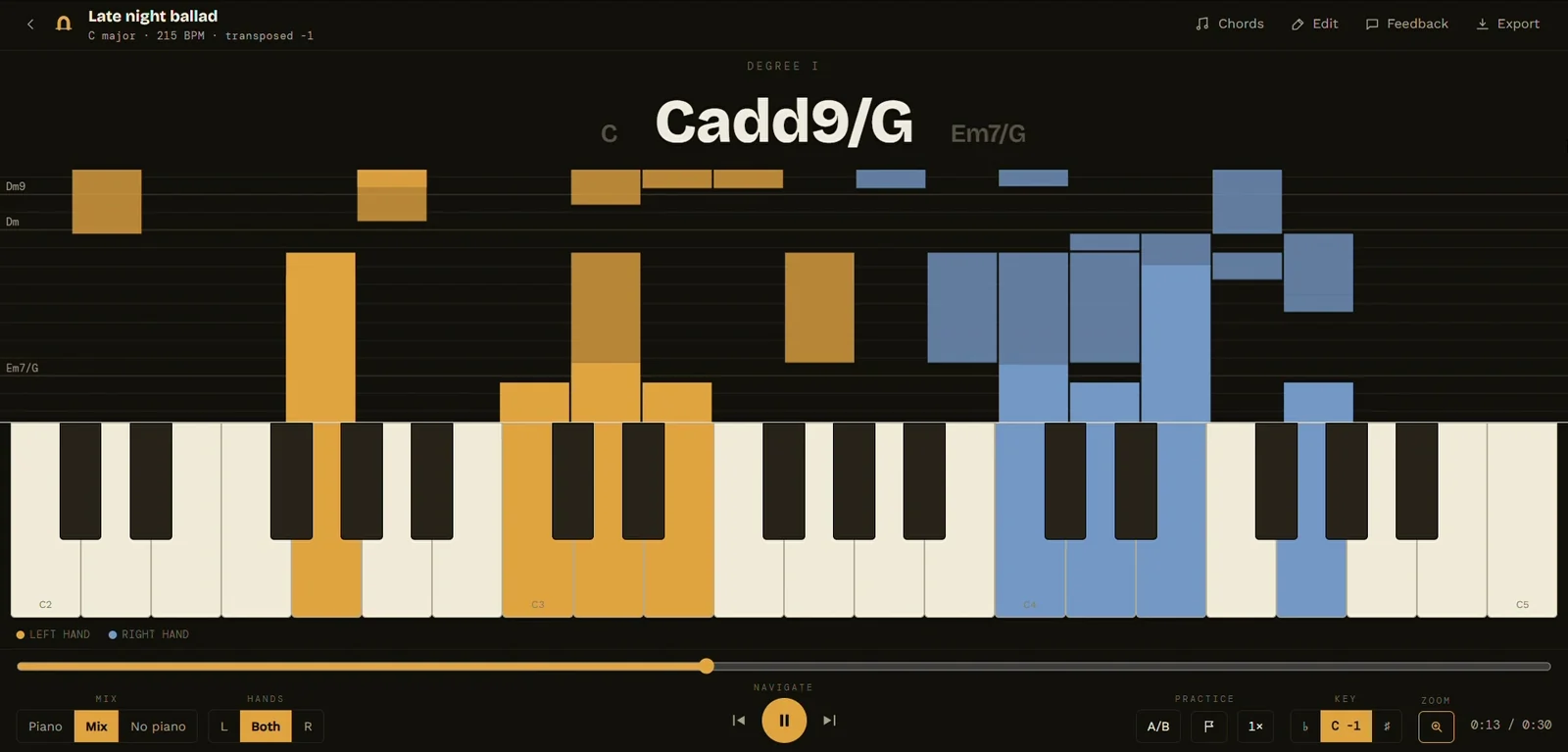
Notes fall onto a keyboard, exactly above the keys they belong to. Left hand in gold, right hand in blue. Chords named the way musicians name them: Gadd9, Em7, D.
Practice, your way
Step through chord by chord, focus one hand, loop the hard bars, slow down, transpose to your key. Everything built for practicing, nothing for scrolling.
What's inside
A practice room, not a player.
Every control exists to help you learn a piece faster, and nothing exists to keep you scrolling.
See each hand on its own.
Neuma splits the part into left and right so you can drill one hand, then bring them together. Gold is your left, blue is your right.
Real chord names.
Gadd9, Em7/G, D: named the way musicians actually read them, in sync with the notes.
Drill the hard four bars.
Set an A/B loop, drop markers on the passages that trip you up, and stay there until it's clean.
Move it to your key.
Shift the whole song to a key that fits your voice or your hands, chord names following along.
Slow down, same pitch.
Take a run at 0.5×, then creep back up to tempo. The pitch never moves, so nothing sounds squeaky.
Share the falling notes.
Save a vertical falling-notes video to post or send to a student, or export the MIDI. Your work leaves with you.
The actual app
This is what you get, not a mockup.
The player you'll practice in.
Notes fall toward the exact key to press, the current chord sits above the keyboard, and the controls stay out of your way.
app.neuma.tools · player
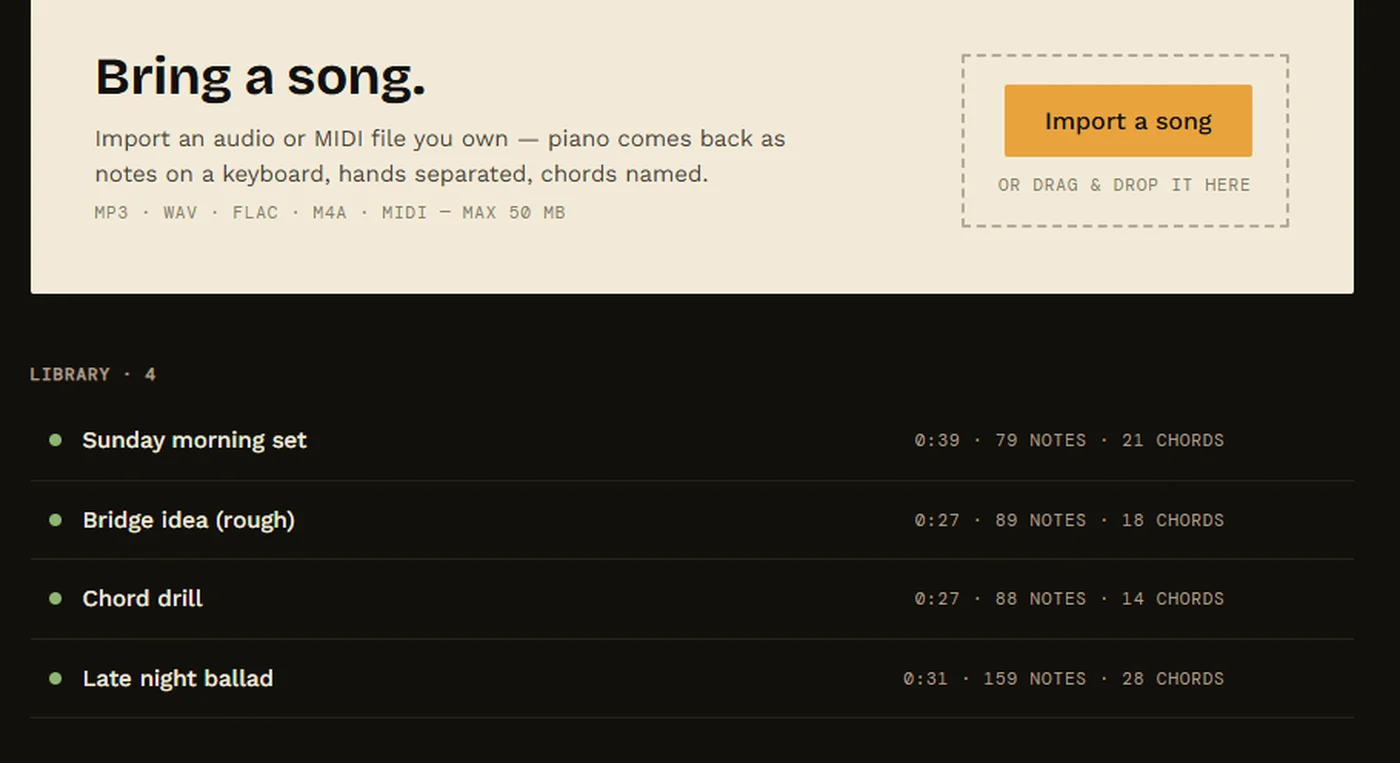
Your library, private by default.
Every song you analyze stays in your own library, with the note count, chord count and length at a glance. Nothing public, nothing shared.
app.neuma.tools · library
In the wild
Import done. Time to play.
MIDI & teaching
Made to pass from hand to hand.
Neuma reads MIDI too. A part you've sequenced, or a teacher's demo, becomes playable in a click and travels cleanly between people.
Exact notes, no detection.
Drop in a MIDI and every note lands exactly, with no audio to second-guess. Neuma still splits the hands and names the chords, and those stay a one-click fix.
Built for teachers.
Record a part once, then share the MIDI for students to import, or send them the finished falling-notes video straight from Neuma. One take, every student.
Every screen
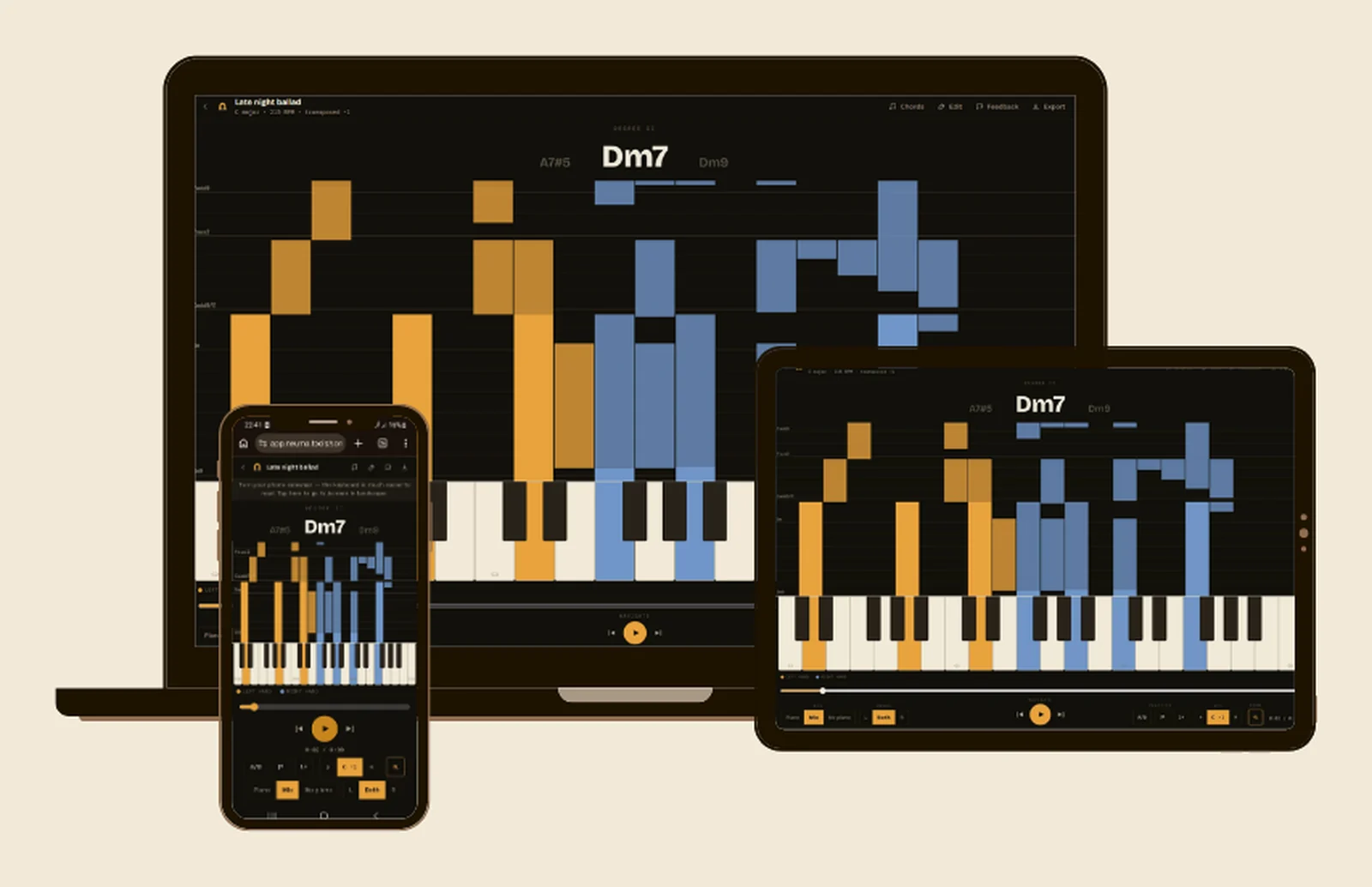
Best on a big screen. Ready on the rest.
Neuma runs in the browser, so it works on a laptop, a tablet, or your phone. A wide keyboard reads easiest on a big screen, but your practice room comes with you.
An honest tool
The AI gets it right most of the time,
and you can fix the rest.
Detection comes from audio, so it can make mistakes on dense mixes.
It's a practice aid, not an engraving tool. Close enough to play is the goal.
Every note's hand is fixable in one click, and your fix sticks.
Pricing
Start free. Upgrade when it clicks.
- 3 songs per month, fully analyzed
- Falling notes, hands, chord names
- Step-by-step practice mode
- Transpose ±1 semitone
- 1 loop & 1 marker per song
- 100 songs per month (fair use)
- Full transposition, any key
- Unlimited loops & markers
- Fine speed control, 0.5 to 1×
- Everything that ships next
The founding rate holds for as long as the subscription stays active. Offered once, at launch.
Questions
The things you actually want to know.
Is this legal? Whose music can I import?
You upload audio you own or have access to, and everything Neuma produces is for your personal practice only. Nothing is ever published, shared, or listed publicly. Your library is yours alone. You are responsible for the files you upload; see the Terms.
How accurate is it?
On piano-forward recordings, most users find the vast majority of notes and chords correct. Dense band mixes are harder: a missed or misread note can also change the chord named above it. You can reassign a note's hand in one click and edit the notes directly, so the version you keep is one you've checked.
Do I need to read sheet music?
No. Neuma shows notes the way piano tutorial videos do, falling toward the exact key to press. If you later read music, the chord names speak that language too.
Can I import a MIDI file?
Yes, and it's the most exact way in. A MIDI file already holds the notes, so there's no audio detection to get wrong. Neuma still works out the left and right hand split, which can need the occasional one-click fix, but the notes and their timing are spot on.
What happens to my audio files?
They are processed to extract the notes, then the original upload is deleted from our servers. The derived practice tracks stay in your private library until you delete them. We never train our models on your data without your explicit opt-in. Details in the Privacy Policy.
Which formats and instruments?
MP3, WAV, FLAC, M4A and OGG, plus MIDI, up to 50 MB. Today Neuma reads the piano part; other instruments are on the roadmap.